
Hey, look, it’s September, and that means, once again, that it’s Brain Aneurysm Awareness Month!
It’s estimated that 2% of the population is walking around with an unruptured brain aneurysm, and while most of them will never cause a problem*, there are still about 30,000 ruptures per year in the U.S., which works out to one every 18 minutes. Which actually seems like kind of a lot, doesn’t it?**
Depending on its location, a ruptured brain aneurysm can (as those who have been hanging around here since, oh, November of 2019 or so may remember) cause a subarachnoid hemorrhage, a particularly severe kind of stroke with a borderline ludicrous fatality rate. This has improved somewhat in recent years with advances in treatment, particularly non-invasive treatments such as coiling:
Outcome has improved over time although the only treatments shown to be effective in adequate, well-controlled clinical trials are nimodipine*** and repair of the ruptured aneurysm by coiling rather than clipping. All other management is based on less evidence, leading to variation in guidelines and management (Tables I and II in the Data Supplement).
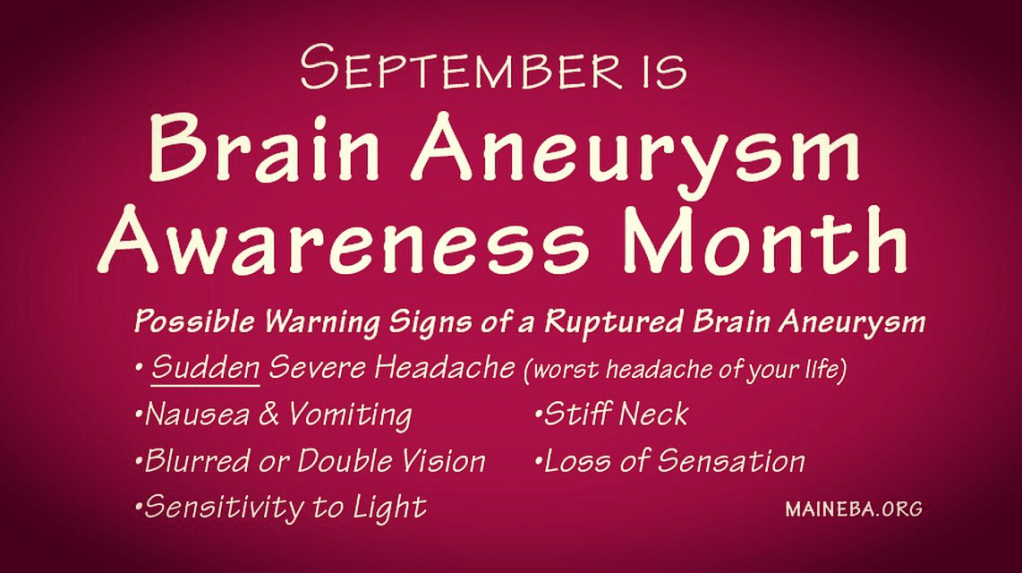
I also recently heard of a new treatment called the “SEAL Device” which is apparently good for large, elongated, or oddly-shaped aneurysms. And of course there’s still the old standby treatment of clipping. The point is not that you should always get one or the other, but that there are options, most of which didn’t exist a few decades ago. At this point one of the primary challenges to successful treatment is getting a correct diagnosis. So let’s recap the symptoms one more time, in case you forgot them after two or three paragraphs:
And remember, kids, if you think you’re having a medical emergency, and you’re wearing your pajamas, don’t bother getting dressed before you call 911.
* This is one reason why aneurysms aren’t routinely scanned for, because if you find a small one, what do you do about it? Do you treat it and risk complications (which can include rupturing), or watch it and risk spontaneous rupture? The best argument for scanning, in my opinion, is that it would allow people to make lifestyle changes to reduce the risk of spontaneous rupture, such as quitting smoking**** or, as in my case, starting medication for blood pressure that is a little bit high but not dangerously so*****. Anyway, it’s a moot point; given that people often don’t get scanned even after presenting at the ER with symptoms, large-scale pre-emptive scanning is never going to happen.
** Something something small probability multiplied by large number something.
*** I was on nimodipine following The Event, including for three weeks after I was discharged. Most SAH patients don’t recover anywhere near as fast as I did, and nimodipine is not the kind of medication you’re going to find on the shelf at your local pharmacy, so if you or someone you know is getting sent home from the hospital absurdly soon after a subarachnoid hemorrhage, be sure to make arrangements to obtain it ahead of time.
**** Which, I mean, you should be quitting smoking anyway.
***** Except for, you know, the undetected aneurysm.

 Viscosity
I didn’t know you experienced an aneurysm. Jesus, man; that’s scary. So glad you made it through. Must’ve been hell… How long did it take to recover?
LikeLiked by 2 people
Not gonna lie, it wasn’t a fun time! After the aneurysm ruptured I was in the hospital for nearly three weeks, all but two or three days of which were spent in ICU. I was back to work after about two months, gradually working back up to full time; I work with computers and it took a while to be able to look at a screen without getting a headache. I also spent several months building back up my time on the rowing machine and my resistances on the Bowflex (all of this was after being cleared for exercise by my neurosurgeon of course). We were back to the dance studio after a couple months as well, but that only lasted a month or two before the pandemic came along and slammed the doors shut for a couple of years. (We were very cautious during the pandemic because, as I said repeatedly during that time, I didn’t want to go back to ICU …)
All of that may sound like a long time but it’s actually an astonishingly fast recovery after a subarachnoid hemorrhage; initially, the ICU nurses were making noises like I could expect to be hospitalized for months (and that has been the experience of many others in the aneurysm group I belong to on Facebook).
LikeLiked by 1 person
Sounds like hell. I’m so glad you made it through; that takes tremendous courage🙏🏼
LikeLike
Glad you were able to recover so quickly. Those are some scary statistics.
LikeLiked by 1 person
Yeah, there are a lot of nasty percentages to be found when you start looking into aneurysms, subarachnoid hemorrhages, and what happens to people who have them, that’s for sure …
LikeLike
Thanks for reminding us of the symptoms. I hope I never have to use this knowledge though. I of course know not to worry about the clothes you are wearing when any medical emergency happens to you because when you get to the hospital you will have to take it off or they will just cut you out of your clothes (I know this from personal experience at age 13 from a bike accident).
LikeLiked by 1 person
This was a lesson I had never learned because although I had made many, many previous visits to the emergency room, they had been for either stitches (as a kid) or kidney stones (as an adult), and none had involved taking my clothes off … 😁
LikeLiked by 1 person
Great reminder – thank you! Linda xx
LikeLiked by 1 person
I forgot to add that with my migraines, they often run brain screens to check that an aneurysm isn’t the underlying cause… 3 scans over 3 decades and the only thing they ever found was a “small brain bleed” in the first test – which they said could happen from a mini-stroke, a fall, from childhood… they never stressed too much about it… can’t imagine what it would be like if the problem was like yours… glad you’re still here to talk about it and drop those important reminders… and yes… no smoking is a big one! Linda xx
LikeLiked by 1 person
Wow! What an ordeal! I’m glad you recovered so quickly.
You mentioned resuming rowing and dancing… so I assume a workout that raises your pulse rate and/or BP is ok… I mean, won’t cause a rupture if you have one?
LikeLiked by 2 people
That’s an excellent question! With an untreated aneurysm, depending on the size and location, they will tell you to avoid things like lifting heavy objects and smoking (of course) and they do generally want you to keep your blood pressure lower. Once the aneurysm is treated, though, depending on the situation, it is usually possible to return to previous activities (still not smoking!). After coiling the aneurysm is filled with platinum wool, basically, which induces a clot and plugs the entire thing up, while after clipping, the “neck” of the aneurysm is closed off, not unlike sealing up a bag of potato chips. Other treatments, like stents and diverters, are also designed to keep blood out of the aneurysm. In all cases pressure in the aneurysm will be greatly reduced.
Of course, before resuming any such activities, the patient would need to get cleared by their doctor (which I did), and then it’s a good idea to slowly work back up to a safe level of exercise where the benefits outweigh the risks. I don’t have any restrictions on activities but I know of lots of other patients who do, either imposed by their doctors or just as a result of the ruptured aneurysm itself.
LikeLiked by 1 person