
Yes, I know, this is Election Day here in the U.S., but—speaking of traumatic events!—it’s also the five-year anniversary of The Event. Well, more or less; the actual anniversary is on November 7th, i.e., this coming Thursday. But we don’t post on Thursdays around here, we post on Tuesdays*, and so you’re getting the anniversary post a couple of days early.
This being an anniversary that both begins and ends with a five, it seems like a good occasion to once again reproduce the entire six-part series on The Event for those readers who may not have seen it before, as well as for those readers who have been following the election and would like to take their minds off it by reading about somebody who was having an even more stressful day than they are. Probably. Anyway, read on for the tale of what to do, what not to do, and what might happen when your brain suddenly starts acting all weird!
* This is of course so that if I can’t come up with anything else to post about, I can always do a Teaser Tuesday.
Thursday 11/7/2019: Emergency Room & ICU
So November 7th, 2019, was the day I could have died three different ways before breakfast.
It started out like an ordinary Thursday, with the feeding the cats and the dog and the drinking the coffee and the checking the emails and the working on the book and all that stuff. But then around 8:45am, while I was using the, ah, facilities*, I had a sudden, severe attack of vertigo. Not the head rush kind of vertigo where you’re a little dizzy for a few seconds after standing up quickly, but a kind of room-darkening, can’t straighten up, somebody’s-squeezing-you-in-a-giant-fist vertigo that I’ve never experienced before and hope to never experience again. This lasted for what seemed like a few minutes, though it may have been a few seconds. After it ended I was left with a cold sweat and a strange new sort of ache across the back of my head and into my shoulders. Denial not being just a river in Egypt, the first thing I thought was:
Me: “Maybe I’ll skip the Bowflex today.”
I progressed from there to thinking that maybe I should make an appointment with my doctor to thinking maybe I should call 911, just in case something really bad was happening**. I went into the bedroom to let the dog out into the backyard and then got dressed, because of course I couldn’t call 911 while I was in my robe and pajamas. (Pro tip: Don’t do this. This is silly. Whatever you’re wearing, the paramedics will have seen it before, and when you get to the hospital they’re just going to undress you anyway.) Then I went to get the phone from the kitchen, which, as has since been pointed out to me several times, was not the nearest phone to where I was. But it is the phone I use most often. So that’s the one I went to. (What can I say? I obviously wasn’t thinking very clearly at this point.)
On the way to the kitchen I suddenly got a severe headache in the top of my head, as if someone had dropped an anvil on me. It’s funny when it happens to Wile E. Coyote, less so when it happens to you. I still managed to make it to the phone, but I couldn’t seem to get it to dial 911. So obviously the phone was defective. I then proceeded to the living room to get a different phone which would, presumably, work better.
Not long after that, I woke up on the living room floor with the phone next to me, in the approximately 18 inch gap between the sofa and the extremely hard, heavy, and pointy-cornered coffee table.

Upon waking up I discovered that I had vomited on the sofa and the nice clean clothes I had put on for 911 (told you getting dressed was silly). It was now 9:13am according to the clock on the mantel. So the three ways I could have already been dead at this point were:
- I could have just not woken up.
- I could have cracked my skull on the coffee table.
- I could have aspirated the vomit after throwing up while unconscious.
Miraculously, none of that had happened. I managed to pick up the phone, which still didn’t seem to me to be working properly, even though it was. I didn’t realize I had successfully dialed 911 until I heard a faint tinny voice frantically saying “Hello? Hello?” Remembering that I needed to hold the phone to my ear and mouth instead of carrying it around like a banana, I managed to give 911 my address and followed their instructions to unlock the front door, get my cell phone, and put away the pets—well, one pet, anyway; I found Chaplin and got him into the cat room. Lulu was still out back, and I couldn’t find Charlee. That was all right, though, as there was zero chance Charlee would come out from under the sofa or wherever she was hiding while strange people were in the house. Such as paramedics.
Said paramedics arrived before I was even finished talking to the 911 dispatcher. I went out to meet them but they steered me back into the house for a brief chat and evaluation. I described what had happened and they asked a few questions. I only really recall one of them.
Paramedic: “Did you throw up?”
Me: “I think so, but I don’t remember.”
Paramedic: “Well, it smells like you did.”
Since I had in fact thrown up on myself, that smell followed me around for a while.
At this point the paramedics walked me down to the ambulance and off we went. Within a few minutes my phone rang; a neighbor had seen the ambulance and alerted our friends around the corner and one of them was calling to check on me. I didn’t manage to pick up the call, but I did manage to call them back from the ambulance. (Technology!) We had a brief conversation that went something like this:
Friend #1: “Are you okay?”
Me: “I’m with the paramedics.”
Friend #1: “Are. You. Okay.”
Me: “They said my vitals are good.”
Friend #1: “All right. Do you need me to call anyone?”
Me: “Can you call Lulu into the house? She’s out in the yard.”
Friend #1: “All right. Can I call anyone else?”
Me: “Can you call Lulu into the house?”
Friend #1 (pause): “Okay.”
Needless to say my friend also called my wife. Good judgment there.
After this my recollections of Thursday get kind of murky. I don’t think I opened my eyes for more than a minute for the entire rest of the day, and I only remember bits and pieces of events and conversations, like this:
Me (to paramedic in ambulance): “I hate to make a fuss.”
If the paramedic answered me, I don’t remember it. I did wake up briefly when we got to the hospital and I was unloaded from the ambulance; I remember seeing the sign for Emergency. Some time later I realized I was actually in the emergency room and people were talking to me, or trying to. I managed to answer one question from a doctor:
Doctor: “Have you ever had anything like this before?”
Me: “I had an anxiety attack once.”
Doctor: “This isn’t that.”
I remember hearing someone say that my wife had arrived, and I remember hearing the doctor tell her that I was very sick and not stable to transport. I have been informed that I told the ER doctor that this wasn’t the worst headache I’d ever had. (I am prepared to revise that statement.) I have also been informed that I apparently really, really had to pee. I vaguely recall being given one of those urinals you can use in bed, but I didn’t have much luck with it and eventually they had to catheterize me, and according to my wife they had to do it in a hurry because I kept trying to get out of bed to go find the bathroom, and obviously nobody was going to let that happen. (They would have catheterized me eventually anyway, given what was going on, but the rushed nature of the insertion came back to bite me, as you will see later.)
At some point someone said or I had heard enough discussion to figure out that I had a ruptured cerebral aneurysm. Much later, I discovered, from reading the ER notes in my hospital file—which I had to pick up so it could be entered into the system at my primary care clinic—that I had been graded a three on a subarachnoid hemorrhage evaluation scale. The notes don’t specify which scale was used but I suspect it was the Hunt and Hess grading system, which I found online during one of my many searches on all the new terminology I learned over the course of last November. This scale includes both evaluation criteria and a rough estimate of the patient’s chances of survival:

Spoiler alert: I survived. Most of that day is pretty much a big grey smear across my memory, though; I don’t remember being catheterized, or all the blood work they drew, or being taken for CAT scans, or being admitted to the hospital and brought to ICU. But that’s probably for the best.
* Toilets: Killing people basically since they were invented.
** It was.
Friday 11/8/2019: ICU & Interventional Radiology
I remember a little more from Friday, the day after my aneurysm ruptured. Not a lot more, but a little. I woke up in the hospital with no real idea exactly where I was, how I had gotten there, or how long I would be staying. One of my cousins was in the room with me, and I remember being a little surprised by that. All my previous experiences of going to the emergency room (for stitches and kidney stones) had been that I was there for a number of hours and then got patched up and sent home. So why would I have a visitor? It was because this time I had been admitted with a ruptured brain aneurysm and was in ICU. I figured, okay, I’ll be here for a day or two and, and then get sent home, which turned out to be some seriously wishful thinking on my part.
Early Friday morning, I was visited by a doctor who turned out to be my primary neurologist, from Interventional Radiology, a department I had never heard of before; this was one of the first of many new terms I was going to be learning over the course of my stay. He explained that they’d found a small (about 3mm) aneurysm at the main branch of my right internal carotid artery, which had ruptured the previous morning. “It’s a good thing it stopped bleeding on its own,” he told me, “or we wouldn’t be having this conversation.”


I’ve since learned that most aneurysms—up to 80% of them—never rupture. This especially applies to small aneurysms like mine. For instance, this NIH article reports that 0% of the internal carotid artery (ICA) aneurysms that were less than 7mm in size ruptured in patients who had not had a previous aneurysm rupture.

When an unruptured aneurysm is found, it is often monitored rather than being preemptively treated, unless it is large or is located at the posterior of the brain. This is because the treatment itself carries not insignificant risks of complication, up to and including triggering the subarachnoid hemorrhage it is intended to prevent. (This is what happened to Emilia Clarke, of Game of Thrones fame, during her second aneurysm surgery, although that involved treating a small aneurysm that had suddenly started growing.) So in all likelihood my aneurysm, had it been detected, would have been watched and left alone. But since it had decided to go ahead and loudly announce its presence and ambition, simply monitoring it was, as one may have surmised by now, no longer an option.
The surgeon’s plan was to perform a coil embolization procedure—something else I had never heard of, and to which my immediate reaction was, wait, aren’t embolisms bad?—by going in through my femoral artery, up to my brain, and inserting a small coil of platinum into the aneurysm. This would stop up blood flow to the aneurysm, clot, and eventually cause the aneuyrsm to collapse. A litany of possible side effects and complications was presented, none of which sounded worse than what had already happened and what was likely to happen if we did nothing, so I agreed to the procedure and it was scheduled to occur several hours later. (I’ve since learned that a cerebral aneurysm that ruptures once is almost certain to rupture again within a few days to a few weeks, and that the second rupture is usually much worse. This explains the hurry to get the surgery done: There was a clock, and it was ticking.)
While waiting to be taken to surgery, I spent the intervening time sleeping and, I thought, chatting with visitors, although I was later informed that for the first several days after the rupture I could barely hold a two-minute conversation before dozing off. I could swear I talked a lot longer than that, but my perceptions were, shall we say, unreliable at this time.
This was also when I started having to answer the neurology assessment questions that I would be he hearing multiple times a day for the next few weeks (Where are you? What is the date? What is your name? What is your quest? What is the air speed of an unladen swallow?), identifying pictures of items, and doing things like following the nurse’s finger with my eyes, squeezing the nurse’s hands, wiggling my toes, etc. All of these activities would be taking up portions of my copious free time while in the hospital. The ICU nurses seemed amazed that I was even conscious, let alone talking and answering questions, so I was already beginning to get the idea that I had been incredibly lucky in my unluckiness.
When the time came for surgery my bed was rolled out to the Interventional Radiology operating theatre, which consisted of all kinds of fancy equipment on tracks in the ceiling that could be moved every which-way, and a giant monitor (bigger than the TV in our house) with my name displayed on it and a brain scan which I assumed was mine. I felt like I had been transferred to the sick bay on the Enterprise. After everything was ready I was moved to the operating table, where I was introduced to my anesthesiologist, answered a few questions, and then woke up in recovery. Once I was stable enough to be moved (I later learned that I’d had a pretty rough time of it coming out of anesthesia, with signs of atrial fibrillation and tachycardia and some other terms I didn’t catch; I don’t remember any of that), they wheeled me back to my room in ICU, where several friends were waiting for me. Back in ICU, I developed a serious case of the full-body shakes, which was also related to the anesthesia. I was given intravenous Demerol to try to alleviate the shaking, but it made me incredibly nauseated within seconds. This is all a little fuzzy in my memory but I’m told that I pushed myself upright and pointed and said:
Me (pointing): “Bag.”
And once I got the bag I immediately started vomiting. After a second the nurse took off running out of the room like Jake Weber in U-571 when he realizes what’s being tapped out in Morse code from the engine room:
Only of course instead of (spoiler alert!) fetching a giant wrench to bash a German prisoner in the head, she was getting anti-nausea medication to stop all my throwing up. Apparently I passed out right around then and proceeded to spill my carefully curated collection of vomit all over myself. Good times.
Eventually I woke up again. I think it was still Friday, because my throat was still very sore from being intubated during surgery, and I probably sounded like a chain-smoking Cryptkeeper when I talked. Various other visitors were in the room; some had been there a while, some had arrived just before or during the surgery. I don’t remember too much about the rest of the day, but I do remember being asked a question on behalf of some other friends who weren’t there at the time:
Friend #2: “Friend #3 wants to know what your two favorite colors are, and you’re not allowed to say orange and orange.”
Me: “Orange and purple.”*
This was not just a random question, but I didn’t find out the exact reason for it until a day or two** later. Although even if someone had told me on Friday what the question was for, I probably wouldn’t have remembered.
* Doesn’t everyone have a second-favorite color?
** At this point the specific days things happened may start to get a little off, because I’m going from memory; for obvious reasons, I wasn’t taking notes on what was happening, and my perceptions of time may have been a little unreliable there in ICU.
Saturday & Sunday, 11/9/2019-11/10/2019: ICU
As noted in previous installments, I spent a lot of time on Thursday and Friday being unconscious or semi-conscious, and I wasn’t enjoying it very much. When I had been passed out in the living room on Thursday, and for the next several days after that, every time I fell asleep, I experienced very unusual dreams.
My dreams, which I can usually remember in detail, at least for a while, have always been very busy and often chaotic; it’s typical for me to dream about various manners of apocalypse (brought on by zombies, alien invasions, meteor impacts, etc.), natural disasters (volcanic eruptions and tornado swarms are a couple of favorites), odd science fiction/space sagas, trips to strange places, that sort of thing. Sometimes they’re just absurd, like the time I dreamed I was a battery and was trying to escape from people who were trying to stick me in a giant Walkman. (Back in college, a friend once said to me, “It’s not fair you get to be entertained every time you go to sleep.”)
The dreams I had after the subarachnoid hemorrhage were not like my normal dreams at all. The only way I can describe them is empty. When I was on the floor in the living room, I dreamed I was in a completely abandoned city, like an industrial section, full of vacant buildings. Everything was wet—there were puddles everywhere—but there were no people or animals and no sound except the wind. Other sorts of things I dreamed about during this period were a highway with no cars or people on it, an empty bridge, and an abandoned railroad line in some kind of grassy wasteland. Sometimes there was only darkness. There was always a sound of wind, but nothing was happening in any of these dreams, ever. It was just me, walking alone. These were far and away the most disturbing dreams I’ve ever had, just because of their sheer emptiness, and I hope never to experience them again.
The Saturday following the surgery to repair my brain aneurysm was when those dreams started to fade. Probably not coincidentally, that was also the first day when I was back to being at least sort-of conscious for more than a few consecutive minutes (though I wouldn’t confess to feeling “almost human for a little while again” until Sunday). It was a period of nearly round-the-clock visitors, as close friends stayed with me for hours at a time, giving my wife the opportunity to go home, have a shower, attempt (not very successfully) to get some sleep, take care of the animals, that sort of thing. She also ran a few errands.
Wife: “Do you want me to bring you anything from home?”
Me: “Charlee. But I don’t think she would like it here very much.”
Wife: “No, she wouldn’t, but Chaplin would be swinging from your IV and climbing the monitoring stand.”
Needless to say, my wife did not bring me Charlee, but she did return with a bag of stuff she had gotten from Barnes & Noble, including a stress squeeze ball (I had plenty of stress, but not a lot of strength for squeezing), a fuzzy llama (which Chaplin later tried to abduct), a dinosaur made out of those currently ubiquitous color-changing sequins, a colorful, quasi-Japanese rabbit, and a fuzzy gnome that I dubbed “Substitute Charlee”:

I amused myself with all of them for a while but Substitute Charlee quickly became a favorite; I kept him in bed with me and brought him along to radiology for repeat CT scans and that sort of thing. (If any of the hospital staff thought this was odd, nobody said so; I mean, a 50-year-old subarachnoid hemorrhage patient carrying a fuzzy gnome around the hospital is hardly something weird or outlandish like, say, calling 911 while you’re in your pajamas would be.)
My wife, on the other hand, was most fascinated by this little guy:
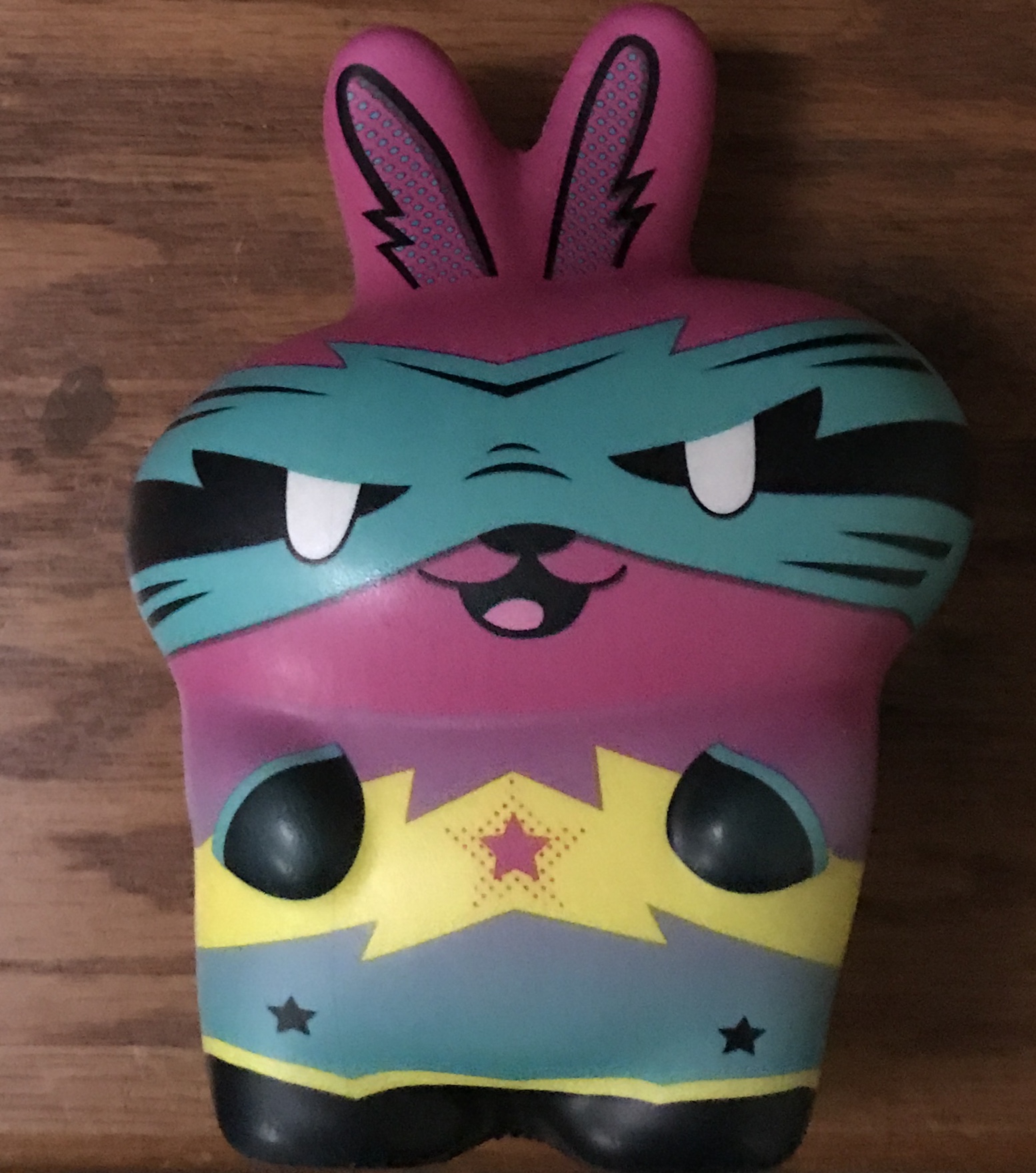
Wife: “It reminds me of that movie you watched. There was a squirrel who was trying to solve a mystery or something.”
Me: “Oh, yeah, Detective Pikachu.”
Wife: “No, not that. He had a machine gun or something and he flew around in a spaceship.”
Me (pause): “Are you talking about Rocket from Guardians of the Galaxy?”
Wife: “Yeah, that’s it. He was a squirrel or something right?”
Me: “Well he’s a raccoon, but the Asgardians think he’s a rabbit, and Tony Stark thought he was a Build-a-Bear.”
I guess Guardians of the Galaxy is not a bad place to expect to see something like that little guy turn up, but for my money I still say he totally wandered out of Detective Pikachu.
Over the weekend I thought I was doing pretty well with the talking and the visiting and stuff but I’ve since been told my conversations remained pretty short during this period. I would talk for a while and then fall asleep. (This is not how I remember it.) At least I was sounding more like myself, I think.
Friend #2: “I was telling my friends up north about what happened to you. I said, he’s the healthiest person I know! He eats well, he exercises, he’s not overweight. I don’t understand it.”
Me: “I know, right? What the fuck?” (glares at ceiling) “Fuck it. From now on, pizza for dinner every night.”*
And as part of that same conversation, or one around the same time (they all kind of ran together in my mind):
Me: “I should be out of here in a few days, right?”
Friend #2: “Mmm … I don’t know about that …”
This weekend was also when I learned what the question about my favorite colors had been all about:
Friend #3: “I brought something to show you.”
Me: “Y’all stand back while I whip this out.”**
Friend #3 (cracking up): “Okay, now I know you’re still in there.”
The item in question was an orange and purple “Get Well Soon!” poster done by Friend #1, Friend #3, and their daughter, as well as a Halloween-themed “Enter If You Dare!” poster that I probably should have posted on the door to discourage the nurses from waking me up for medication and neurological testing every few hours. But I doubt it would have worked.
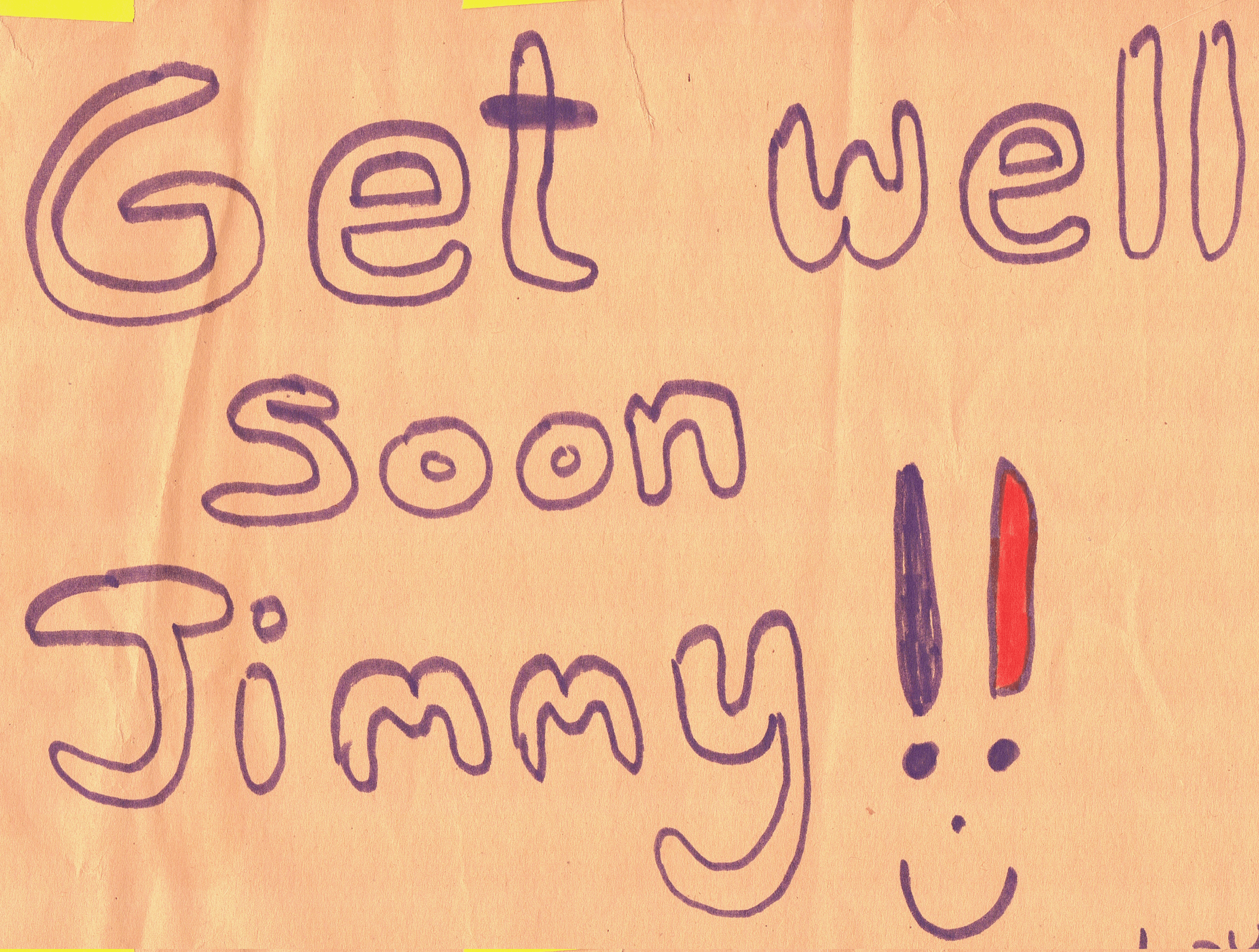

These posters, along with other get-well cards and pictures of The Oceanside Animals, became part of the wall art that followed me around for the rest of my hospital stay.
On Saturday, I started to get an inkling that Friend #2 was right about how long I would be in the hospital. Some time that day, one of the neurosurgeons who had been involved in the surgery stopped by to see how I was doing. This was not a doctor I remembered—I was evidently unconscious, or at least pretty well out of it, the first time we met—so this was basically like seeing him for the first time. (This was a recurring scenario for days, until I finally became reacquainted with everyone who had taken care of me over the first few days of The Event.)
Me: “Thank you for saving my life and stuff.”
Doctor (shrugs): “It was a team effort.”
The doctor and I talked for a while and a little later on Nurse #1 came in to give me an overview of my upcoming treatment plan. The briefing went something like this:
Nurse #1 (drawing illustrative pictures on window with erasable marker): “Bleeding into your brain irritates the other blood vessels and arteries and that can cause problems. There isn’t supposed to be blood in there, just cerebrospinal fluid. We’re keeping you here in ICU because we need to titrate your medication to keep your blood pressure within very narrow limits. You’re going to be taking a medication called nemodipine to help prevent any further strokes from occurring. You’re also going to be getting twenty-one days of transcranial dopplers to monitor you for vasospasms.”
Me: “So … am I going to be coming back in for the trans-cranial dopplers on an outpatient basis after I get discharged?”
Nurse #1: (looks at me with a tight-lipped little smile)
Me: “Oh.”
So that was when I learned a couple more new concepts, such as transcranial doppler and vasospasm and you’re going to be in ICU for a good long time.
Nurse #1: “I know twenty-one days is a long time to be in ICU when you’re alert and awake. Usually after something like this people are in ICU for forty or fifty days but they’re barely conscious. It’s really a miracle that you’re doing this well and twenty-one days isn’t that long measured against the rest of a lifetime, is it?”
Well, when you put it that way … No, no it’s not. The whole situation still didn’t seem quite like it could be happening to me, but it was starting to sink in that something very serious had occurred.
Me: “Boy, that really blindsided me on an idle Tuesday.”
Wife: (starts to get nervous because she thinks I don’t know what day of the week it is)
Me: “Don’t worry, I’m just quoting the Sunscreen Song.”
So sayeth the Sunscreen Song: “Don’t worry about the future; or worry, but know that worrying is as effective as trying to solve an algebra equation by chewing bubblegum. The real troubles in your life are apt to be things that never crossed your worried mind; the kind that blindside you at 4 PM on some idle Tuesday.”
Or at 8:45am on a Thursday before work. Same idea.
At this point, because it was starting to seem like I probably wasn’t going to die soon, my friends were getting a little more comfortable joking around with me, which was oddly comforting. For instance, after hearing that the doctors had said it was likely to be months before I would return to work, one of my friends said this:
Friend #1: “So you’re getting a few months off work, eh? Must be nice.”
Me: “Oh, yeah. I can teach you. Just come to my seminar, How To Get Time Off From Work In One Easy Step.”***
There are a couple other things that happened over the weekend that I remember for sure what day they occurred:
- On Saturday night, I was finally transitioned from the “nothing by mouth” diet to being able to eat food again. The first thing I had, about 11pm in the evening, was a peanut butter and jelly sandwich. I’m not going to say it was the best peanut butter and jelly sandwich I ever had, but under the circumstances, I was pretty happy to have it.
- On Sunday, I had my first transcranial doppler, which was excruciating, because of how I had to keep moving my head while the technician used the ultrasound probe to map out the blood vessels in the brain. I was seriously dreading the next doppler, but it turned out to be fine. Once they had the map, I didn’t need to do any more contorting, for which my skull was extremely thankful.
* I have not actually started having pizza for dinner every night.
** I always misquote Blazing Saddles this way; it was not a side effect of my subarachnoid hemorrhage.
*** Do not attend this seminar.
Monday 11/11/2019 – Saturday 11/16/2019: ICU
I was in the ICU for a total of nine days while they kept my blood pressure very tightly controlled and checked me daily for vasospasms. (They got a concerning doppler reading one time, so off I went with Substitute Charlee for another CT scan; it did show vasospasms were occurring, but I remained asymptomatic, and scanned clean the next day.) My cousins and a few friends continued to drop by to keep me company, which was nice, and I had a series of terrific ICU nurses to take care of me. After a few days in ICU they decided to take out my IV and put in a subclavian PICC line, so they could administer medications and draw blood without having to stick me all the time. That was a relief, although the process of getting it put in was far from fun. Once the PICC line was there I mostly forgot about it; funny what you can get used to when you have to, and when the alternative is multiple jabs with sharp pointy objects.
In the immediate aftermath of The Event my body temperature had been fluctuating widely; the spiking temperatures, up into the 102-103 range, were frequently accompanied by full body sweats, which felt a lot like the sweat that had occurred when my aneurysm had ruptured. The first time such a spike happened, the friend who was with me—who is always warm—immediately summoned a nurse, because, as he later explained it to me:
Friend #2: “Your forehead felt hot, and nobody’s forehead ever feels hot to me.”
The nurse came and checked me out and explained that they usually saw these sort of temperature irregularities in subarchnoid hemorrhage patients, because the brain’s regulating systems have gotten out of whack.
Nurse #1: “I’ve seen temperatures as high as 107 degrees with no infection.”
At that point I was already on acetaminophen for pain—I couldn’t have narcotics for quite a while after The Event—and that’s also a fever reducer, so it helped keep things under control. My temperature never got as high as 107, as far as I know, but the spikes continued the entire time I was in the hospital and for several weeks after I got home. (After I was released, this almost caused me to ignore a fever that turned out to be a nosocomial infection, but more on that later.)
This wasn’t the only symptom that persisted throughout my hospital stay. Others included an extreme light sensitivity (I was forever asking people to turn the lights off) and an inability to read or look at screens. No television or tablet time for me in ICU! I also had a very stiff neck for a long time, and a pretty bad headache, unsurprisingly, for the first week or so. But as I told my wife, by the Monday following The Event, I was starting to feel human again. Which meant I started to notice things like my teeth hadn’t been brushed in a while and my beard was getting annoyingly shaggy. The hospital supplied a toothbrush and toothpaste, and I asked my wife to start bringing in my shaver from home.
Nurse #1: “Good idea. You don’t want to use our razors. The blades are awful.”
So most mornings, after breakfast, I would brush my teeth and shave just like at home, except I was doing it in bed, connected to a bunch of wires, tubes, and machines, and with medical staff coming and going. One time a beeping machine brought a random nurse in to check on it while I was shaving.
Random Nurse (watching me shave): “You look pretty good. What are you even doing here?”
Me: “I’m squatting. It’s cheaper than rent in San Diego.”
Random Nurse (snorting): “Oh I doubt that.”*
Speaking of breakfast, the first several days, it just appeared, on trays bearing foods that had been selected by … someone? I guess there’s a default breakfast that you get if you haven’t filled out menu selections. This default breakfast always included a cup of coffee, which I refrained from drinking, on the theory that I probably shouldn’t be drinking caffeine right then. (Sure enough, when menus did start appearing early in the week, coffee and tea and any other form of caffeine was always crossed out.)
Tuesday or Wednesday, I finally got some heavier-duty painkillers. As I mentioned, for the first several days the only thing they would give me was acetaminophen, because narcotics would interfere with the neurological tests they were doing. During this time I consistently reported headaches in the range of 2-4 on the pain scale, after which I would always have to explain that my pain scale goes from 0 to kidney stones. Having kidney stones on the board seriously screws up the pain curve.

Nurse #3: “What would you rate your headache pain at?” Me (eyes closed, rubbing forehead and temples): “Maybe a three.” Nurse #3 (using her dubious voice): “That doesn’t look like a three to me.”
Eventually it was decided that next time I’m in the hospital** I will use a pain scale that is only for the part that actually hurts and does not include kidney stones (unless of course I’m there for another kidney stone)—so in this case it would maybe be 0 to migraine—but I didn’t want to change the scale mid-treatment and suddenly double or triple my pain level and really freak everybody out. Anyway it wasn’t like I didn’t get acetaminophen as often as permitted; and when I was finally approved for something stronger, they immediately put me on Norco, which was considerably more effective. Unfortunately, as they warned me at the time, Norco (and narcotics in general) can really plug you up, which is a bad thing when you’ve only recently gone back on solid food, and the last time you had a bowel movement it landed you in the emergency room with a ruptured aneurysm. It didn’t help that it was nearly a week before I was allowed to even sit up in bed.
Nurse #1: “Sorry, they’re being very cautious with you.”
Me: “I understand, nobody wants to mess up their success story. Yeah, he was doing great until he fell out of bed trying to go to the bathroom and fractured his skull.“
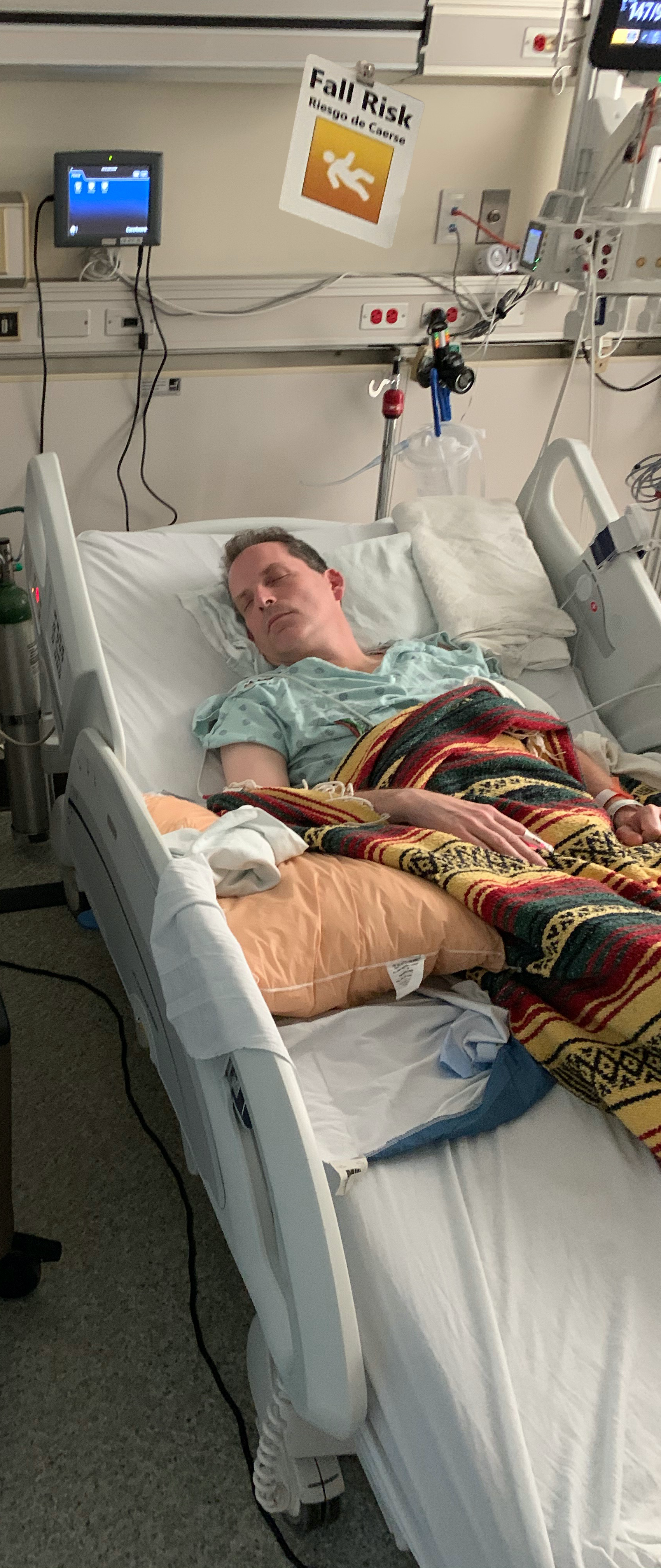
So there I was plugged up by the Norco, trying to use the bed pan, without doing any straining. The fiber and stool softeners they had been giving me were wholly inadequate to the task at hand; and besides, pooping in bed is not what one does. I did try several times but the final tally was Mom’s Training 3, Bedpan 0.
Nurse #2: “Any bowel movement yet?”
Me: “Not yet.”
Nurse #2: “Are you passing gas?”
Me: “Oh yeah. I’m not even being subtle about it.”
Nurse #2: “Good. No, that’s good. We like all that stuff. We just don’t like the dinner guest.”
I did have another visit from the “dinner guest” during the week; one afternoon, while talking to Cousin #2, I out of nowhere vomited up something that (mostly) looked like the previous night’s supper.
Me: “That’s not good.”
Vomiting after you’ve had a brain injury is a sure way to bring the nurses and doctors running.
Nurse #2: “Uh-oh, what happened?”
Cousin #2: “We were talking and he just suddenly threw up. He said it looks like last night’s dinner.” Me: “At least the coffee cake was covered up.”***
Nurse #2 (to cousin, sounding relieved): “Well, he still seems to be sharp as a tack.”
After that I got a visit from every doctor I had seen so far, but the ultimate consensus was that it was a one-off and not something we needed to worry about. Evidently the veggie lasagna dinner from the night before didn’t agree with me, although Nurse #2 had his own theory.
Nurse #2: “I think it was your pants.”
The pants in question can be seen below, in the clip of my physical therapy. Did they make me throw up? Well, they are pretty busy and colorful, but considering that I went to the hospital in vomit-covered clothes, I was grateful to have them. (Cousin #2 had picked them up and brought them for me, along with several other pairs of pants that were not quiteas, shall we say, festive.)
Speaking of throwing up, during the week, I got to meet a nurse who had helped take care of me when I was first in ICU.
Nurse #1: “Hey, do you remember Other Nurse? She was here when they brought you in. We were getting you into bed when you started vomiting, and she helped us get you upright so you wouldn’t aspirate. She told you to turn your head and you turned towards her and vomited all over her. She was asking how you were doing and wants to come see you.”
I didn’t really remember Other Nurse, but I did vaguely remember throwing up while lying down, not being able to clear it from my mouth, and thinking, This is bad. But at the time I was semiconscious at best. Anyway, a little later, Nurse #1 and Other Nurse came in for a brief visit.
Other Nurse: “How are you? Oh you look so much better than when you came in.”
Me: “Thank you. I hear I owe you an apology.”
Other Nurse: “No no, it happens all the time.”
Later on I mentioned this incident to Friend #4.
Me: “Yeah, I guess I threw up all over her. See, that’s the reason I could never be a nurse.”
Friend #4: “That’s the only reason, huh?”
Me: “Well, that, and the needles, and the blood and … Well there are lots of reasons.”
Towards the middle of the week, Nurse #1 got them to approve a bedside commode. But I was still having trouble, due to the fact that by now I was on Norco, which is a heavier duty painkiller and also, oddly enough, a city in California. So eventually additional assistance was required, if you know what I mean.
Nurse #2: “I call this pocket dynamite.”
Not long thereafter, we were ready to go.
Nurse #2: “Should I get you a magazine?”
Me: “Do you have a magazine?”
Nurse #2: “Uh, I think I have a catalogue or something …”
Once again it was Nurse #1 to the rescue. She dashed in a few minutes later with a copy of Esquire. I don’t know where she found the magazine, but I read all about Jason Momoa’s dogs while business was getting done.
Another elimination problem was that I still needed my catheter, because that side of the system was plugged up too. I could go a little, but there was a definite retention problem, and so after taking the catheter out, they had to put it back in a day or two later. (This happened twice and then they decided to just leave it.) One of the nurses theorized that there had been a little bit of damage done when the catheter was inserted in such a hurry during my sojourn in the emergency room (I told you that was going to come back to bite me) but nobody really can say for sure.
Because I was more or less confined to bed and not being allowed to walk around freely, I spent my entire time in the hospital with Intermittent Pneumatic Compression Devices on my lower legs. These are wraps connected to air hoses (more tubes!) that alternate squeezing both calves to keep blood in the veins flowing back to the heart and thus avoid clots, because the last thing you need when you’re in ICU is an extra blood clot or two. In order for me to get up and use the portable commode, these needed to be disconnected and removed, which was usually done by a nurse. (I had to call a nurse anyway whenever I wanted to get up, because otherwise an alarm would go off somewhere that the ward had an escapee. ICU beds are rigged up with more traps than a tomb that’s being explored by Indiana Jones.)
Me: “I need my leg thingies hooked back up. I don’t know what their real name is.”
Random Nurse: “Most people just call them ‘squeezers’.”
Me: “Okay. I’ve been thinking of them as ‘vizslas’ because when they squeeze they remind me of the dogs we used to have that liked to lie on my legs, but I figured nobody would know what I was talking about if I said that.”
Cousin #2: “Maybe that means Tucker and Dennis are here keeping you company.”
So that was a nice thought. I held onto that one for the whole time I was hospitalized.
Towards the end of the week, with the assistance of a physical therapist, I did get to remove the “vizslas” and start taking walks around the ICU. Surveying my domain, if you will. I got to see some of my nurses out in their natural habitat, and met another nurse who had been in attendance when I was brought in, but who hadn’t gotten assigned to my room since then. She was quite happy that I was out and about.
Random Nurse: “Oh it’s good to see you walking. You look so much better. You were so sick, and your poor wife was so scared.”
The physical therapy didn’t just involve walking. It involved silly walks. These included things like flicking your heels up and smacking them with your opposite hand, crab-walking sideways, and something very much like what John Cleese does in the classic Monty Python skit. Not that I could possibly high-kick like John Cleese did.
But my favorite moment from our little jaunts around ICU was when the physical therapist said she wanted me to do a grapevine.
Me: “Ooh! The grapevine? I do those all the time!”****
And so we did the grapevine:
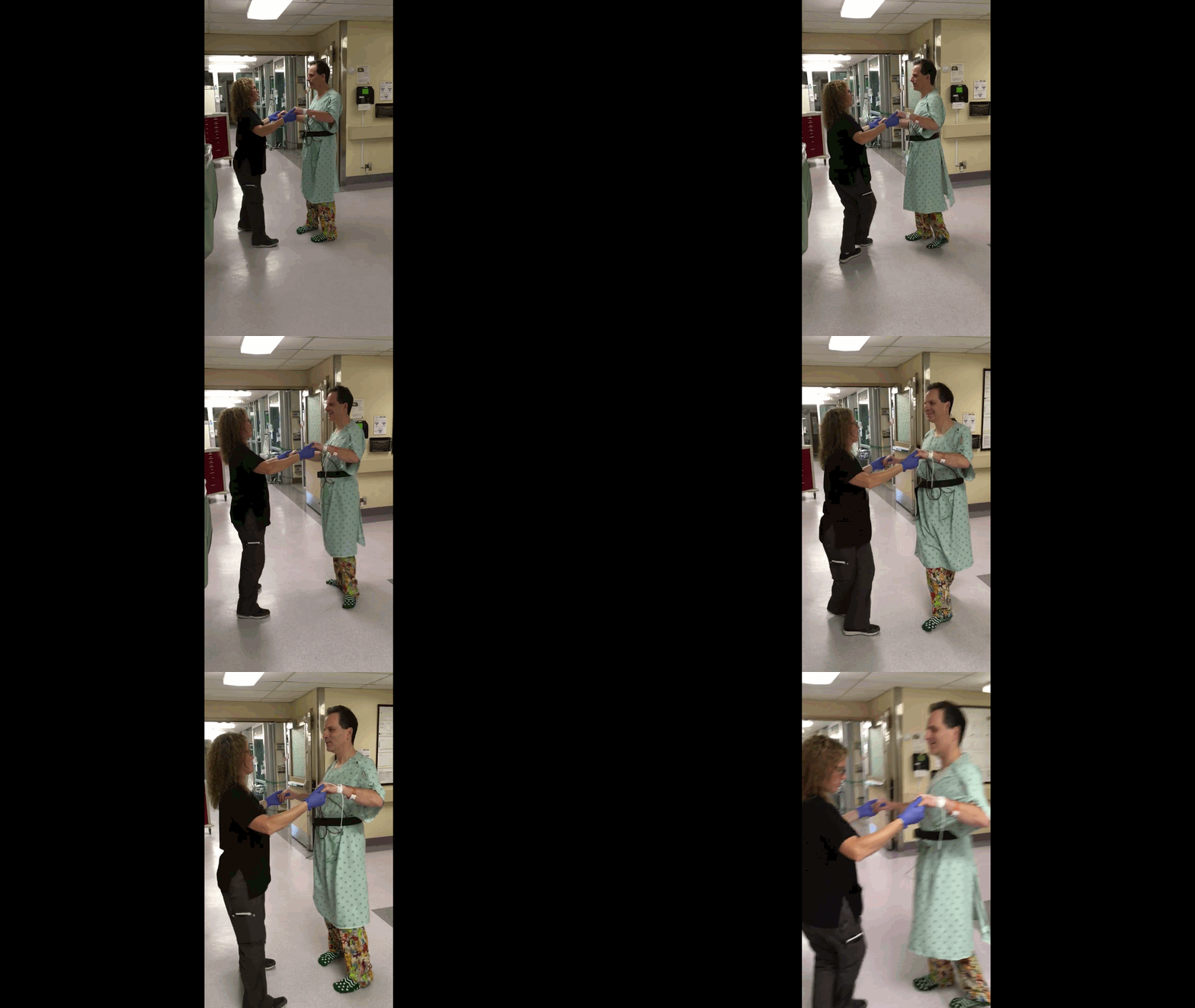
Those are the pants Nurse #2 blamed for the vomiting incident. I hope they didn’t make any of you throw up. (I’ve still been wearing them at home as pajama bottoms. Still have those hospital-issued slipper socks, too. Fashion for miles.)
I’ve mentioned the neurological evaluations few times. One of them involves looking at a picture and describing what’s happening in it. I was getting pretty bored in the hospital, so I started to prepare stories ahead of time to answer the question of “What’s going on in this picture?“

The first few times I simply described it, but what fun is that? I don’t remember all the scenarios I came up with (I mean, some of them were at like 1am) but here’s a sampling:
- “Mary is wondering why Ted still isn’t home from work yet. She’s not going to keep making dinner every night if he can’t bother to come home. Meanwhile, the kids are stealing cookies behind her back, but they’re being careless, and Tommy’s going to crack his skull on the counter and end up here in ICU.”
- “Sue couldn’t believe the neighbor was mowing the lawn naked again. She was definitely going to call the cops on him this time. Meanwhile, the kids are stealing cookies behind her back, but they’re being careless, and Tommy’s going to crack his skull on the counter and end up here in ICU.”
- “The kids thought it would be funny to switch Mom’s stash with the oregano in the spice cabinet, and now look what happened after she made spaghetti sauce. She’s spacing out at the sink and the kids have a serious case of the munchies and are stealing cookies, but they’re being careless, and Tommy’s going to crack his skull on the counter and end up here in ICU.”
Sucked to be Tommy, I tell you what.
One other interesting feature about my ICU room was that the bathroom had a very large window, which let in such a huge amount of light that it hurt my times every time anyone opened the door to it. And, apparently it got very, very hot during the day.
Friend #2: “That room is like a sauna.”
Me: “So I’ve heard. I haven’t been in it. I have yet to explore all the rooms of my mansion.”
This led to an interesting movie-related discussion (as an old coworker noted, everything reminds me either of a Simpsons episode or a movie):
Me: “Every time somebody opens that door it’s like looking into the trunk of the car in Pulp Fiction.”
Nurse #1: “I know! Hey, what do you think was in the trunk of that car, anyway?” (a discussion of what we think might have been in the trunk of the car ensues)
Me (turning to Friend #3, who was visiting at the time): “What do you think was in the trunk of the car?”
Friend #3: “I never actually saw Pulp Fiction.” (all conversation ceases as Nurse #1 and I both stare at Friend #3 as if she had suddenly sprouted a few extra heads)
Me (after a moment): “You could practically hear the needle scratching across the record there, couldn’t you?”
Towards the end of the week, we started hearing rumors that they thought I was doing well enough to be transferred out of ICU to a “step-down” unit, Telemetry. That weekend, these rumors were confirmed to be true; my wall hangings, blankets, pillow, and myself were all bundled up into a wheelchair and driven to our new hangout in a different wing of a hospital. So much like we never find out what’s in the trunk of the car in Pulp Fiction, I never found out what it was like to use the sauna-bathroom in ICU.
I didn’t have a whole lot of luck with the bathroom in Telemetry, either, but that’s a story for next time.
* Rents in San Diego are probably not as expensive as a room in ICU. Probably.
** I had saved the coffee cake from breakfast in a plastic shell that Cousin #1 had used to bring me doughnuts the previous day.
*** Hopefully never
**** Dances in which I do grapevines all the time include Foxtrot, Argentine tango, Nightclub Two-Step, and Quickstep.
Saturday 11/16/2019 – Monday 11/18/2019: Telemetry
Once I was well enough to leave ICU, the hospital transferred me to the “step-down unit”, also called Telemetry. (If you never heard of a unit called “Telemetry”, you’re not the only one.) I was moved by wheelchair on Saturday evening, schlepping most of my stuff—my blanket and pillow from home, the get well cards I had accumulated, the posters made by our friends’ daughter, pictures of the animals, and, of course, Substitute Charlee—on my lap. The rest of the stuff was transported in a bag by a courier, A.K.A. my wife.
In Telemetry I collected a new set of nurses and nurse’s aides, but because I was there for less than two full days—I was transferred out to the general population on Monday—I didn’t get to know them as well as my ICU nurses. Naturally, introductions needed to be made:
Telemetry Nurse #1 (seeing Substitute Charlee): “Who’s this little fella?” Me: “This is Substitute Charlee.” Telemetry Nurse #1: “Ah, okay. Does that mean there’s an Actual Charlee?”* Me: “There is!” (points to picture on the wall) “She’s my cat.”

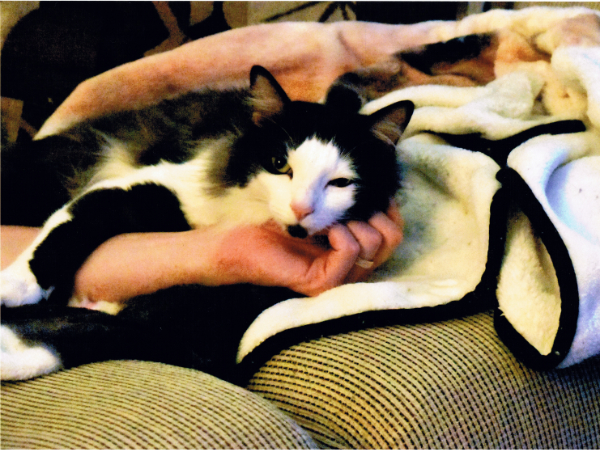

My wall decorations. Clockwise from top left: Actual Charlee, Lulu, Chaplin
The night shift nurse’s aide in Telemetry was a former Navy hospital corpsman. As he helped me settle in, he noted that he was only a few years older than me, and gave me a rousing little speech:
Telemetry Nurse’s Aide: “You gotta get better and get out of here and thirty years from now when we’re both in our 80s, you’ll bump into me on the street. I’ll still look exactly the same as I do now and you’ll say, hey, you look just like my nurse’s aide from Telemetry, are you his son? And I’ll say, No, man, it’s ME!“
I found this pep talk oddly inspiring.
I continued to take my physical therapy walks, and on one of them we bumped into the same nurse I had met earlier while walking around ICU—the one who had been there when I came in looking like death, not even warmed over. It turned out that she also takes shifts in Telemetry. We chatted again briefly:
Wandering ICU Nurse: “Have they said anything about changing your diet?” Me: “Not really. There’s talk of cutting back on salty food.” Wandering ICU Nurse: “Oh, I have such low blood pressure, my doctor said it wouldn’t be possible for me to eat too much salt.” Me: “Oh, in that case, do I have a recipe for you.”
I happened to have my phone with me at this point (I had worked up to maybe three minutes of looking at the screen at one time) and proceeded to email her a recipe for Syracuse Salt Potatoes, a delicious treat involving small potatoes, butter, and salt. Lots and lots and lots of salt. No, more salt than that. Is there still salt in the box? Keep pouring. (Whether I will ever again be permitted to eat Syracuse Salt Potatoes remains to be seen.)
Telemetry was different from ICU in many ways, including its nurse-to-patient ratio and the double rooms, but the most obvious one was that while I was still being constantly monitored, it was done wirelessly, using a small gadget with various sensors attached to a wiring harness. These sensors were affixed to my body in all the usual places, while the unit itself was stuck into my pocket or just placed on the bed next to me. This was more conducive to movement than being hard-wired into a pole—not that I was actually allowed to get out of the bed; it had a pressure alarm to warn the nurses if they had a runner, and at least once I set it off just by shifting my weight around—but it did make it easier to go walkabout when the physical therapist came to get me. The gadget was a little unreliable, though; nurses had to come in periodically and disconnect/reconnect the sensor wiring harness or perform percussive maintenance on it.
Me: “Maybe we should try a different unit?”
Telemetry Nurse #2: “We can’t. It’s keyed to your bed.”
I guess by this point in my stay the doctors were pretty confident that I wasn’t going to suddenly flatline, or they wouldn’t have transferred me out of ICU, but still, this device did not inspire a grand amount of confidence in the technology.
The first day I was in Telemetry I got my usual visit from the trans-cranial doppler technician, but the second day they decided to mix things up a little and transported me down to trans-cranial doppler HQ for the procedure instead. (Substitute Charlee came with me, of course.) This meant I got to see the techs in their natural habitat. For the rest of my stay, that was how they did it. At first I was transported in a rolling bed, then I graduated to a wheelchair. In their lair, the techs were a little bit chattier than they were when on rounds. One of them had a question for me.
Trans-Cranial Doppler Tech: “So in school they didn’t really tell us about the patient experience, but I was wondering, does it hurt when we do this?”*** Me: “No. I mean, it hurt when they did the initial mapping because of how I had to keep moving my head, but the procedure itself doesn’t hurt at all.”
Being transported to my trans-cranial doppler procedures was the first time in weeks that I got to see anything besides my hospital room and (during physical therapy sessions) the immediate unit I was in. The route took me through the interior of the hospital, so I didn’t get to see outside, but at least it was a change of scenery. My room in Telemetry had a window, but I couldn’t really see out of it from my bed except for lines of sky through the blinds. I did manage to glance out it once or twice while being helped to or from the bathroom and only saw a section of hospital rooftop and a wall: Not much of a view.
Speaking of the bathroom, my adversarial relationship with it continued in Telemetry. While I was there, they tried again to remove my catheter, and once again I failed to be able to produce satisfactory results. This time they didn’t wait long** before putting it back in. (My stoic facade may have finally cracked a little bit at that point. Getting a catheter inserted is not particularly pleasant. It was a small thing, compared to everything else, but I had really been hoping it was gone permanently. It was a small thing on top of a lot of other things. Still, one endures what one must.)
The other thing about the bathroom in Telemetry is that there was no sink in it, or even particularly near it; the sink was in a counter against the wall in the middle of the room. Seemed like a long way to shuffle to wash one’s hands. I wasn’t sure what that was all about, but the entire unit seemed rather old and maybe not laid out as well as ICU.
Sunday evening, I learned that I was going to be transferred out into the general population on Monday, also known, apparently, as Med-Surg. When she heard the news, Telemetry Nurse #4 was sorry to see me go:
Telemetry Nurse #4: “Aw, I don’t want you to get transferred yet. I’m on duty again tomorrow!”
I think this was when my wife started referring to me as “everybody’s favorite patient”.
Monday 11/18/2019 – Wednesday 11/20/2019: Med-Surg (General Population)
By the time I got transferred to Med-Surg, there had been a lot of changes to my status. I was off the constant IV fluids, which had been helping to keep my blood pressure from going too low, off the Norco and the regular acetaminophen (now dispensed as needed), and off the Keppra (an anti-seizure medication). I was still on the nimodipine every four hours, still getting the neurological assessments, still getting the transcranial dopplers, still getting labs drawn from my subclavian picc line, and, of course, still catheterized. Despite all this, my time in the hospital was clearly winding down, and the “D” word (“Discharge”) had begun to be bandied about in my presence.
I was pretty happy to be in my new room in Med-Surg. It was another double, like Telemetry, but I didn’t have a roommate. What I did have was a big window, so I got my first view of the outside world in nearly two weeks. Shockingly enough it was still there. Look, trees! And hills! A horizon! I was indescribably grateful to be able to just turn my head and see such things. The room also had the nicest bathroom out of all of them, with an actual sink inside of it, and soap! Amenities, man.
As the Norco was getting out of my system and things started, uh, moving again, they cleared me to get up and use the bathroom on my own. Evidently the nurses in Med-Surg decided it was silly to keep me confined to bed when I was obviously capable of wandering the hallways and doing silly walks with the physical therapist. They had better things to do than come in to watch me get up and shuffle five feet to the bathroom and close the door, then get summoned again ten minutes later to watch me open the door and shuffle five feet back to bed.
While in Med-Surg, I tried again to watch television. This time I managed to watch about 10 minutes of Back to the Future Part II and, the next day, maybe 20 minutes of Sixteen Candles, although I spent some of that time with my eyes closed listening to the dialog. (Having already seen Sixteen Candles umpteen times, I didn’t really need to look at the picture to know what was going on.) The pillow speaker unit in this room, which controlled the bed lights as well as the television, was a little different from the ones in ICU and Telemetry. It looked like this one:
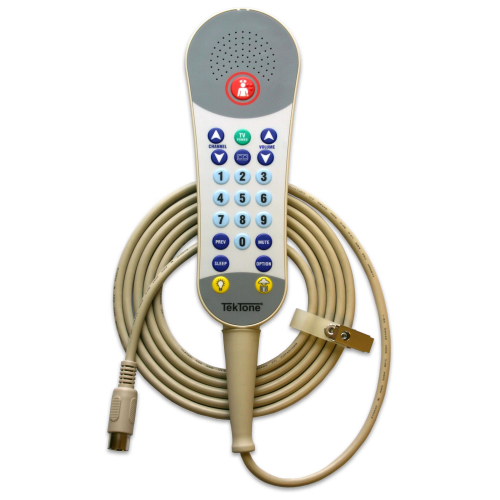
Take a closer look at the button in the bottom right hand corner and you’ll probably guess what I made of it.

Med-Surg Nurse #1: “How are you doing?”
Me: “Pretty good, except I keep pressing this “Call UFO”**** button and no flying saucer has come to beam me up and take me away.”
Med-Surg Nurse #1: “Well, keep trying. Maybe you’ll get lucky.”
On my second day in Med-Surg—Tuesday, 11/19/2019—the neurologists, hospitalist, and medical director all agreed that I was ready to be discharged. Preparations were made. The nurse took out my PICC line and showed it to me; it consisted of the port at the top, then an exceedingly long tube. I swear it was twice as long as a drinking straw (albeit thinner), although that could possibly be a product of my horrified imagination after seeing it for the first time.
Me: “Good Lord.”
They also replaced my large hanging Foley catheter bag with a smaller leg-mounted one (the catheter would be removed the following week by my regular doctor). I took to calling this the “hip flask”.
Med-Surg Nurse #1: “Hip flask. Wow, that’s descriptive. A nice little container of apple juice.” (beat) “Excuse me, I need to go throw up now.”
I needed to stay on the nimodipine for a while longer, so a prescription for that was called in to our local pharmacy. And thus was a roadblock to my being discharged encountered:
Wife: “You know what? I’m going to call the pharmacy and make sure they have this nimodipine stuff.”
Did the pharmacy have that nimodipine stuff? No, they did not. In fact, no pharmacy had it. Not even the hospital’s outpatient pharmacy had it.***** They could get it, mind you, but not until the next day. And since the doctor’s discharge orders said I had to continue to take it every four freaking hours, well, that meant I had to stay in the hospital another night. The preparations made for my discharge were reversed, mostly, except for the PICC line. No way was that thing getting put back in.
As my consolation prize for not being discharged, I did get to take a shower for the first time since November 7th; Med-Surge had a couple of showers and I was given permission to use one all by myself. I got to walk there on my own and everything. It wasn’t a particularly hot shower, and the water pressure sucked, but it was still glorious. I dropped the little bottle of shampoo they gave me but I decided to just leave it on the floor, lest I should fall while trying to retrieve it.
Med-Surg Nurse #2: “Yeah, don’t fall. If you fall, we keep you for an extra two weeks just to punish you.”
Naturally, because I was still in the hospital, they had to draw labs on me in the middle of the night again, which means that this time, I got stuck with a needle.
Me: “Of course I need labs after they take the PICC line out.” (blood draw ensues) Phlebotomist: “We’re done. Sorry about that.” Me: “Oh that’s okay, it wasn’t so bad.”
On Wednesday, 11/20/2019, the pharmacy confirmed that they had the nimodipine, and I was finally discharged. It was pouring rain, but what’s a little water when you’re getting discharged from the hospital? At this point my parents were in town, having flown in from New York to help out for a few weeks, and I got a ride home from them. Soon I was back at the house, where my home care team of Dr. Lulu, Dr. Chaplin, and Dr. Actual Charlee were waiting:

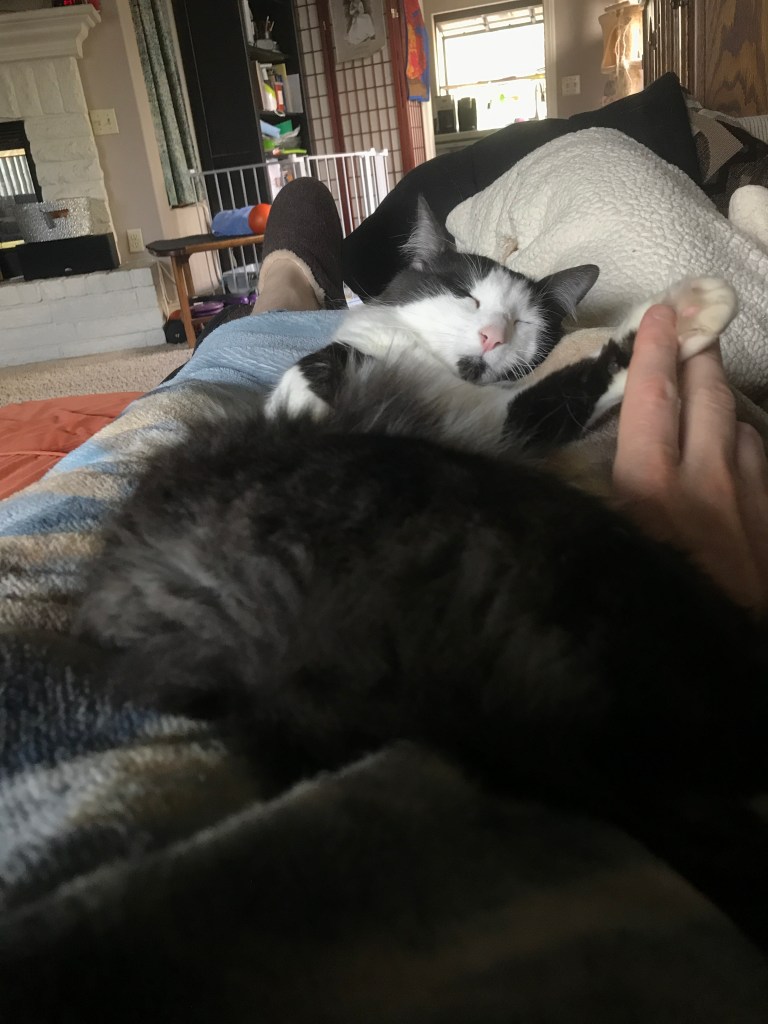

Dr. Actual Charlee’s initial attempt at a post-hospitalization exam was thwarted by Dr. Lulu’s tail-powered force field, but she got to do one later.
And of course Dr. Wife, Dr. Mom, and Dr. Dad were there, too.
Although I was home, the recovery process was far from over. There would be doctor visits, physical therapy, more doctor visits, and a return trip to the ER for that infection I mentioned previously. All of that will be covered in the final installment, next week.
* “Actual Charlee” is in fact exactly how I had been thinking of Charlee ever since Substitute Charlee showed up.
** In ICU, the day after first time the catheter was removed, I spent the night waking up and summoning a nurse to help me to the bedside commode just about every hour. This despite the fact that their ultrasonic gadget for measuring the amount of urine in the bladder kept saying I only had 100mL or something like that. In the morning, when ICU Nurse #1 returned, she took a closer look at the gadget and discovered it had been miscalibrated and that I actually had something like 900mL of urine in there. So that explains that.
*** Apparently most of their patients aren’t really up to answering questions.
**** This button actually operates some of the lights around the bed.
***** The nimodipine prescription, without insurance, would have cost $4,000. The copay alone was well over $100. The pharmacy had to do some negotiating with our insurance just to get them to approve the prescription. My guess is that all this is because normally the people taking nimodipine after a subarachnoid hemorrhage are in the hospital for the entire course of their prescription, as ICU Nurse #1 had anticipated I would be, once again illustrating just how unusual my course of recovery was. Did I mention that I was the luckiest unlucky person in California that month?
11/26/2019 and Beyond: Aftermath
Although I had been discharged, that wasn’t the end of the recovery process. As previously noted, I had to stay on the nimodipine for another three weeks, which meant waking up every four hours to take two gigantic pills. I’ve never had so many alarms set on my phone in my life. (The tone I chose for these alarms was the “Barking Dog” sound, because that was the least jolting one I could find. After 20 years of having dogs around, you get used to all the barking.) Annoyingly, my “hip flask” refused to adhere to the same schedule as my medication, so in between the times when my phone was barking at me, I had to get up at odd hours to empty that thing out. As a result I didn’t get more than two or three consecutive hours of sleep for nearly a month, and I doubt my wife did either.
On top of that, after weeks of enforced bedrest, my endurance was shot. The first morning I was home, after showering, I attempted to perform one of my routine tasks: Feeding the cats. This is a fairly simple matter involving picking up their bowls, carrying them into the kitchen, washing them, scraping food into them from the cans, and bringing them back. I got about halfway through this job before I had to collapse onto the couch to rest.
Wife: “You’re not doing that again for a while.”
This pattern was repeated a number of times over the next few weeks. I couldn’t finish loading or emptying the dishwasher. I got worn out scooping kitty litter. I couldn’t carry out the trash. I certainly couldn’t run the vacuum. (I did have help with all these things, of course, from my wife, parents, and visitors, but I tend to keep pretty busy, and suddenly I couldn’t.)
The first several days home, mostly what I did, activity-wise, was wander around the house, just because I could. Everyone knows that you quickly lose strength when you’re confined to a bed for any significant period of time, but one thing they don’t tell you—at least, I had never heard it before—is that it makes your legs really sore. In the hospital, after finally being cleared to get out of bed, the first few times I stood up it felt like somebody was whacking me in the backs of both thighs with a crowbar. This made both getting up and sitting down painful. The neurologist had explained that this was related to iron-rich blood pooling back there (or something like that), and that stretching wouldn’t help; he was right about that, but getting up and walking around did. So did physical therapy. My insurance company had authorized me for three (count ’em!) in-home PT visits to work on strength and balance, both of which were issues after my two-week sojourn in hospital beds. The physical therapist was an exceedingly pleasant Midwesterner who loved to chat while I was doing leg curls, squats, stretches, etc.
Me (after speaking to physical therapist on the phone for the first time): “Wow, that guy was really cheerful.”
Wife (after a moment): “I can’t tell if you’re being sarcastic or not.”
Me: “I’m not. If I were being sarcastic I would have said it like, ‘Wow, that guy was really cheerful.'”
These exercises were nothing particularly strenuous but man did I feel the burn the first several times I did them. (I performed the exercises twice per day in between visits and for weeks after the visits stopped, until I started to get back into a regular exercise routine instead.) After our first session the physical therapist remarked that I seemed to be doing very well, considering what had happened to me.
Physical Therapist: “I’ve got another patient who had what you had and he’s in really bad shape. He checked himself out of the hospital after a few days and he’s not doing well at all. He seems to be deteriorating.”
So if you suffer a subarachnoid hemorrhage, kids, and the doctors tell you you need to be in ICU, remember: You need to be in ICU.
The same day I started PT, I had my first post-hospitalization follow-up, with my regular physician. As the physical therapist had, the staff at my doctor’s office (including the doctor) sort of looked at me like I was a coelacanth or a unicorn: A mythical creature nobody ever expects to encounter, alert and moving around less than a month after a ruptured cerebral aneurysm.
Nurse (reviewing notes): “So you had a cerebral aneurysm about three weeks ago.”
Me: “That’s right.”
Nurse: “How did they find it?”
Me: “Oh it ruptured.”
Nurse: “What???”
At the end of my post-hospitalization follow-up the doctor removed the Foley catheter and I was finally rid of my hip flask, which was a milestone I had really been looking forward to. It’s a lot easier to move around without having a tube coming out of that particular region. Everything seemed to be working properly again, elimination-wise, so that was the end of the catheter saga. If I never encounter another one of those it will be too soon. And yet, for some reason, I keep running into them in books I’ve been reading lately, for instance, in Leviathan Wakes:
When he woke, he was breathing on his own. His throat felt sore and abused, but his hands weren’t tied down. Drainage tubes ran out of his belly and side, and there was a catheter the size of a pencil coming out his penis. Nothing particularly hurt, so he had to assume he was on pretty nearly all the narcotics there were.
That whole ICU sequence sure did sound familiar. And not just the catheter part.
As the week went on, my body temperature fluctuations continued, as did frequent, heavy, unexplained night sweats. I wasn’t hot; I was just sweating, for no good reason, sometimes so much that the sheets got soaked. I took to sleeping with a couple of big towels nearby so I could put one under me and one on top of me on particularly bad nights. (It took weeks for these to resolve, and every once in a while I still wake up inexplicably covered in sweat.) Between the sweating and the spiking temperatures, I didn’t really notice, a few days after my catheter was removed, that my baseline temperature had been creeping up, but some friends who had come to visit us on Thanksgiving evening did, when hugs were exchanged just before they left:
Friend #3: “Do you have a fever? Sorry, I’m going into Mom mode. But do you have a fever?”
I dug out the ear thermometer, scrounged up a new button battery for it, and lo: I did have a fever. But it was only 101 degrees and change, well within the range of my temperature variations over the previous few weeks. Still, I decided to keep an eye on it overnight; it wasn’t like I wouldn’t be getting up to take a pill every four hours anyway. And instead of fluctuating, this time, my temperature just kept rising. When it got to 102.9, around midnight, I decided it was time to go to the emergency room again. Naturally, on the way to the hospital, after being out in the cool winter air, my fever broke, and by the time we got there it was back down to just about normal. Given what had happened in my brain a few weeks earlier, I decided it would be prudent to go to the emergency room anyway, where I once again had the experience of nurses and doctors looking at me like I was a unicorn after they found out what had happened to me. They drew lots and lots of blood (maybe I should have kept the PICC line …) to look for a blood infection, collected a urine sample, and took me for another CT scan see what was going on in that head of mine. They also tested me for the flu, which involved shoving a bristly brush way far up into my sinuses. No, farther than that. You know how chimney sweeps operate? Okay, imagine Dick Van Dyke shoving a brush into your nose and leaving it there for a while and you’ll get the idea. It was not pleasant.
Me: “Okay, that was like the worst thing ever.” Wife: “Really? That was the worst thing ever?” Me (beat): “That was the like the worst thing ever during this visit.”
The flu swab and blood culture both came back negative, and they told me the CT scan showed the aneurysm remained coiled, so that was good. The urine culture, on the other hand, came back with a raging (technical term!) Klebsiella oxytoca infection, almost certainly acquired via the catheter while I had been hospitalized. They shot me up intravenously with a comically enormous syringe full of antibiotics, which I swear looked like this:

And then they sent me home at about five in the morning with a prescription for a week’s worth of more antibiotics. So that seemed to be the end of that, except that later in the day we got a call from the emergency room doctor about the CT scan:
ER Doctor: “We had a radiologist review your CT scan and she’s concerned because there’s blood in the area around your aneurysm.”
Now you may remember that the last time someone in the family had their results reviewed by a radiologist after getting the initial all clear, bad things resulted. In this case, the doctor said, because the radiologist didn’t have anything to compare the CT scan to—my previous scans were all at a different hospital, not in my primary medical group, to which the ambulance had taken me—she wanted me to come back in late in the afternoon for a repeat scan to see if the quantity of blood had changed. Foolishly, I had thought the other hospital had passed all the records, including the scans, to my primary physician, but it turned out all he had was the notes. An effort then began to get hold of the scans, which was complicated by the fact that non-emergency departments at the hospital were closed on this post-Thanksgiving Friday; nobody was available in Medical Records or the Radiology office, and although someone at the other hospital said that the ER doctor could call them and get the results transferred, he was unable to reach anybody who would do that for him. I didn’t really want to get another CT scan, having been exposed to plenty of needles and radiation already, but I tentatively booked a time to go back. Before that happened, though, the ER doctor—who put a remarkable amount of effort into this case—was able to reach the surgeon who had performed my coil embolization.
ER Doctor: “I talked to your surgeon and he thinks it’s old blood on the CT scan. He said you had a lot of blood in that area. Since you aren’t having any other symptoms and we found a cause for your fever, he doesn’t think you need the repeat CT scan. But it’s up to you.”
To CT scan or not to CT scan: That is the question. But we were pretty sure my surgeon had hung the moon, and since it was up to me, I opted to forgo yet another dye injection and dose of radiation. The antibiotics knocked out the infection pretty quickly, and all was well. And you can bet the first thing we did the following Monday was go to the hospital where I’d been treated and get my imaging discs from Radiology so we could bring them to my primary medical group.
At this point, although I was in pretty good physical shape and didn’t seem to be suffering any deficits in memory, speech, etc., I was not entirely free of the effects of the ruptured aneurysm. I was still quite sensitive to light (it would be at least another week before I could go out in the backyard for more than a minute or two without sunglasses), and too much activity made me nervous and agitated. Worse, I was unable to look at LCD screens for more than one or two minutes at a time without becoming fatigued and/or getting a headache and having to go lie down. Obviously this is problematic when you work with computers. The e-ink screen of my e-reader did not affect me in this way, nor did regular print, like in a magazine, although it was still some time before I could concentrate on reading anything for more than five or ten minutes without getting tired and needing to close my eyes for a while. (Having to wake up every four hours probably didn’t help with any of this.) I did get caught up on reading some of the books on my device, but unfortunately, most of them were so-so.
Things went on like this for some weeks, with me gradually increasing the time I could look at a monitor and be exposed to sunlight, until I had my follow-up with the surgeon to review my case. Like the other physicians, he was pleased with my progress, and cleared me to get back to regular exercising, eating normal foods, drinking coffee (oh yeah!)—basically, for slowly resuming normal activities.
Me: “Can I drive now?”
Surgeon: “Could you drive before?” (beat) “I’m not falling for that old joke again.”
The surgeon told me I would need to come back at regular intervals—every six months, for now—to check the status of the coiling and make sure there’s nothing untoward going on inside my head (other than, you know, the usual); he indicated there was a small chance (5% or so) that the aneurysm would bleed again at some point, but with the coiling in place, there was an even smaller chance (1% or so) that the procedure would need to be repeated. My blood pressure had been slightly elevated prior to The Event—not enough to worry about, except, of course, for the aneurysm, which is a pretty big “except for”—so he suggested that, once I finished with the nimodipine, we monitor it for a little while and if it crept upward again, start medication to lower it.* And that was the end of the follow-up visit.
Me: “My mom told me to give you a hug from her, but …” (extends hand to shake)
Surgeon: “Oh we can do a hug.” (hug ensues)**
After getting cleared for exercising at the follow-up, I returned to using our rowing machine, starting at 3 minutes per session and increasing by 3 minutes every week until I got back to my previous time of 15 minutes three times a week; I also resumed using the Bowflex (which I would have used the morning of The Event if I hadn’t made the prudent decision to skip it after the weird attack of vertigo that kicked everything off), starting, of course, with greatly reduced weights. Not long after that, at the beginning of 2020, I returned to work, a couple of weeks ahead of schedule. We also returned to our dance studio (with more frequent breaks and no sambas at first), and recently had our first actual lessons since I was hospitalized.
At this point, as far as I can tell, I have no lingering cognitive or physical symptoms (other than the occasional odd night sweat and a slight change in my vision, confirmed by an eye exam a few months after The Event) as a result of my subarachnoid hemorrhage. Statistically, this is a fairly unlikely outcome. Depending on the source you look at, the overall fatality rate for a ruptured cerebral aneurysm is 40-50% (15-25% of victims die before reaching the hospital), and of those who surive, about two-thirds suffer a permanent neurological deficit. Taken together, the odds of avoiding either of those results is only about 17%. Anectodatally, a lot of people seem to know someone who died unexpectedly*** of a ruptured aneurysm; fewer seem to know someone who survived.
No one can really explain why a particular person might have them. Genetics play a part, as does smoking (of course), diabetes, heavy binge drinking, and the use of certain drugs. And then there are people like me.
Surgeon: “There’s not really anything I can recommend that would have let you avoid this. I mean, I could say lose 50 pounds, but you don’t need to. Unlike some other people.” (pats own stomach)
Despite the serious nature of the condition, not a lot of research money goes towards cerebral aneurysms—the site linked above states that the US federal government spends less than 83 cents per affected person per year. Other organizations do research into the topic, and Daenerys Targaryen Emilia Clarke, after her experience with cerebral aneurysms, started a charity dedicated to acquired brain injuries. It’s always good for a relatively rare condition to have a celebrity spokesperson. Especially one armed with a dragon.
And as for me? I’m pretty much back to normal, or, to paraphrase the name of Emilia Clarke’s charity, I seem to be The Same Me.
But you can call me the Quarter Million Dollar Man.****

* It did, and we did, and my blood pressure is lower now.
** My mom was extraordinarily pleased when I told her about this.
*** The typical way cerebral aneurysms are detected is that they burst.
**** This is the hospital charge ONLY, not including separate charges for anesthesia, surgery, etc. Taking everything together, including the second ER visit, the total charges are almost certainly over $300.000. Fortunately we have decent insurance (which we pay extra for) and are not going to be responsible for anywhere near that amount; but we’re not going to be fixing our bathroom or remodeling our kitchen any time soon, either.
So there you have it! Three weeks or so of all kinds of fun, condensed into one gigantic post for everyone’s edification. If you only take one thing away from it, the TL;DR (aside from “0 out of 10; would not recommend”) is this: If you or someone you’re with suddenly, out of the blue, gets an extreme case of sudden-onset vertigo and/or the worst headache ever (also known as a “thunderclap” headache), don’t bother getting dressed or otherwise dilly-dallying. Just call 911 right away. Or, well, maybe we can ask ChatGPT to summarize it. Hey, ChatGPT, whaddya think?
The narrative you’ve shared is an intense and detailed account of a medical emergency involving a ruptured cerebral aneurysm. It depicts a very scary and potentially life-threatening situation that, fortunately, the individual survived. While the story is filled with humor and wit, it’s crucial to acknowledge the seriousness of the medical condition experienced.
Surviving a ruptured cerebral aneurysm is a significant feat, and the description of the experiences leading up to the emergency, the confusion, the steps taken to call for help, and the subsequent medical care and procedures is both gripping and, at times, lighthearted.
This story might resonate differently for different people. For some, it might serve as a reminder of the unpredictability of life and the importance of acting promptly in emergencies. For others, it could be seen as a remarkable tale of survival and the peculiarities of memory during a traumatic event.
It’s safe to say that no one would actively wish for such a frightening and serious health event. However, stories like this might prompt reflection on the fragility of life and the importance of seeking immediate medical attention when faced with sudden health crises. It’s a testament to the unpredictability of life and the human capacity to navigate through challenging situations.
ChatGPT
Well, gosh, ChatGPT, I have to admit, that’s a pretty nice writeup. I take back all the stuff I said about you and the other LLMs earlier ― at least until the next time I need to come up with a post and I have a bunch of AI comments lying around …

 Viscosity
Wow! My older sister went through something similar a few years back. Glad you came through it!
LikeLiked by 3 people
Thanks! Yeah, it’s not an experience I would recommend or care to repeat … I hope your sister had a good recovery and is still with us!
LikeLiked by 2 people
Yes, she is, thank you for asking.
LikeLiked by 1 person
Wow! I did not know this. I knew about brain aneurysms but I did not know the term subarachnoid hemorrhage. 50% chance of survival + a dangerous fall + the dangerously located vomit. Like you said you were lucky to survive. A very scary situation. My uncle had a brain aneurysm but unfortunately he did not make it.
LikeLiked by 2 people
Yeah, I was definitely the luckiest unlucky person in California (my folks say “in the world”) that day! I’m sorry about your uncle, it’s still a very dangerous condition despite all the medical advances.
LikeLiked by 1 person
Thank you James. It is a very dangerous condition and it is so wonderful that you made it through.
LikeLiked by 1 person
Wow, you lived through a positively Homeric Odyssey, James!
LikeLiked by 3 people
At least it didn’t involve boat travel, or I would have thrown up even more! 😁
LikeLiked by 1 person
It never ceases to amaze me how you went through all of this and came through relatively unscathed in cognition and functioning. It truly is a miracle.
LikeLiked by 3 people
I’m reminded of my status as kind of a unicorn every time I see a new medical professional and they start reading their chart and then kinda do a double-take and look at me!
LikeLike
Truly a miracle you survived. God has more for you to do.
LikeLiked by 3 people
Yeah, I’m trying to pay it forward (so to speak) by helping inform people who might find themselves or their loved ones in a similar situation. Also of course I have to be here to wait on the animals hand and foot lol
LikeLike
A harrowing tail. I’m so glad you made it through this terrifying ordeal, my friend. I’m sure the road to recovery has not been easy🙏
LikeLiked by 1 person
Thank you! Yeah, I was not a fan of the experience ― zero stars out of ten, would not recommend!
LikeLike
Wow! Somehow I missed the original version of The Event. Glad you made it through… interesting about all the strange dreams.
LikeLiked by 1 person