
So recently (well, by the time this appears, probably around a month) ago, I was reading New Watch, the fifth book in the “Night Watch” trilogy*, by Sergei Lukyanenko, translated from the Russian by Andrew Bromfield:
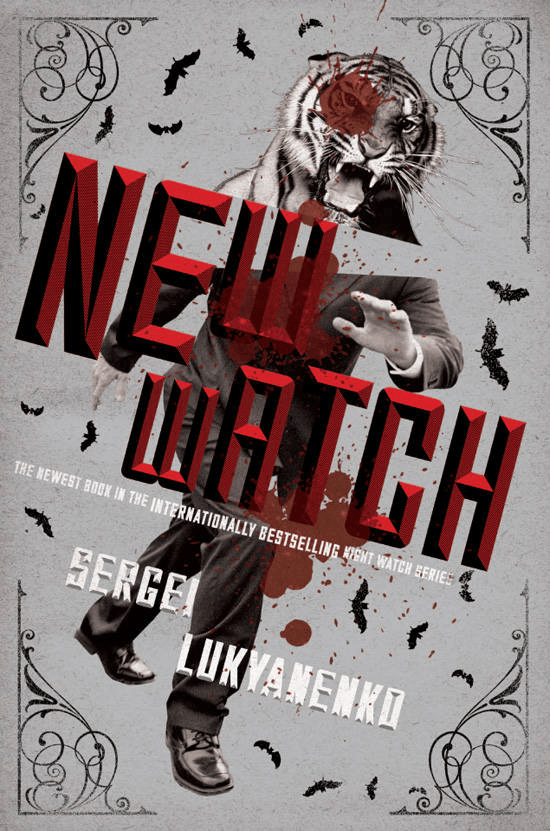
The premise of New Watch, like the premise of all the “Watch” books that I’ve read so far, is that, in addition to your standard regular humans, the world is occupied by “Others”—magicians, witches, vampires, lycanthropes, etc.—who are roughly divided into “Light” camps and “Dark” camps, each of which constitutes, respectively, the Night Watch and the Day Watch. What do they watch? Each other, of course. The Light Others keep an eye on what the Dark ones get up to during the night, and the Dark others keep an eye on what the Light ones get up to during the day; hence the names of the Watches, which may, at first glance, appear to be reversed. Oh and then there’s the Inquisition**, which keeps an eye on both of them.
Now, based on that description of Light and Dark and vampires and werewolves and whatnot, the reader who is familiar with how fantasy novels generally work may have come to the conclusion that these books are simple tales of Good Guys and Bad Guys, with Harry Potter and company lined up on one side and Voldemort and the Death Eaters lined up on the other. This is in fact far from the case. The Dark ones may be somewhat more inclined to self-interest and the Light ones more to altruism, but the lines are blurry and far from black and white. In any given book, both Watches are more likely to lend each other assistance at crucial points against some greater-scope threat, even while they’re jockeying for their own advantage. And sometimes, as in New Watch, the situation becomes dire enough that neither side has any good options.
Arina shrugged.
“I’m simply choosing the lesser evil,” I added.
“Even when choosing the lesser evil, never forget that you’re still choosing evil,” Arina said seriously.
“But in choosing nothing, we choose both the greater and the lesser evil at once,” I replied.
Sergei Lukyanenko, New Watch
If you choose not to decide, you still have made a choice, right?
Incidentally, around 20 years ago they made a movie out of the first book in the series (and, apparently at some point, the second one). I saw it quite a while ago, before I read the book, thus violating my usual rule of “read the book first”.
I honestly don’t remember the movie all that well, but I think I liked it.
* Just go with it.
** What a show!

 Viscosity
Big dilema. Even when we think about society and trying to fight for better life conditions, we have to make a lot of choices like that.
LikeLiked by 1 person
interesting character and plot set-up. it’s certainly easier on the brain than how the Dune books were weaved together, which is what this reminds me of. great review!
-Archer
LikeLiked by 1 person